

We had a total of eight naturalist beginners to expert on the hike.

Along the two hour walk we were in the woods protected from most of the wind which was blowing hard up above in the tree tops some 75 feet or more above. This civil war era fortress was constructed on a hill overlooking Washington DC from the east side of the Anacostia River. At the apex of the fortress hill there was a commanding view of the city and everything around it. We could see all the major landmarks from Brookland's Basilica, National Cathedral, Capitol dome in scaffolding this year, the whole of Roslyn Va. the Pentagon and Air Force memorial sculpture, looking around to National Airport and the rivers that wrap around them all as well as closer in view the Navy Yard and a stadium... It was astonishing to see this all from one vantage point. The point of this trip wasn't sight seeing but that was a nice bonus thanks to Mary Pat stopping to show us the commanding views before we trekked off into the woods. Once inside the woods we got tips on how to tell one type of oak from the next and many other tree's by the shapes of their leaves and the bark on the mature tree. Some we scratched to get a sniff of the scent in the plant like Sassafras and Spice bush.

First view of the trail shows that someone decided to dump some tires and we could see how the invasive plants seem to grow mostly at the edges of the woods. She explained that the soil isn't rich in the right ways to support them in the depths of the woods where the natives still rule.

Right off I was looking for plants I knew to point out. The green Brier a vine that has sharp long thorns was the first after poison ivy and English ivy that came to view. This plant had rich blue berries hanging on the mostly bare stems. They form low thickets that are refuge for birds and small animals. But I didnt' know there were two types of green brier plant until the other type was pointed out. It is smaller and has a longer oval type leaf and is light color on the underside. The thorns on the vine are much smaller but there are dozens of them compared to the smooth green brier. Very distinctive the two plants are so different but similar in a few ways.


Next think I noticed was a fallen tree covered with my favorite fungus I called lichen. I now realize I was wrong, it is a type of fungus classified with mushrooms. That caused some debate we also discovered another type of mushroom also growing on the same logs.

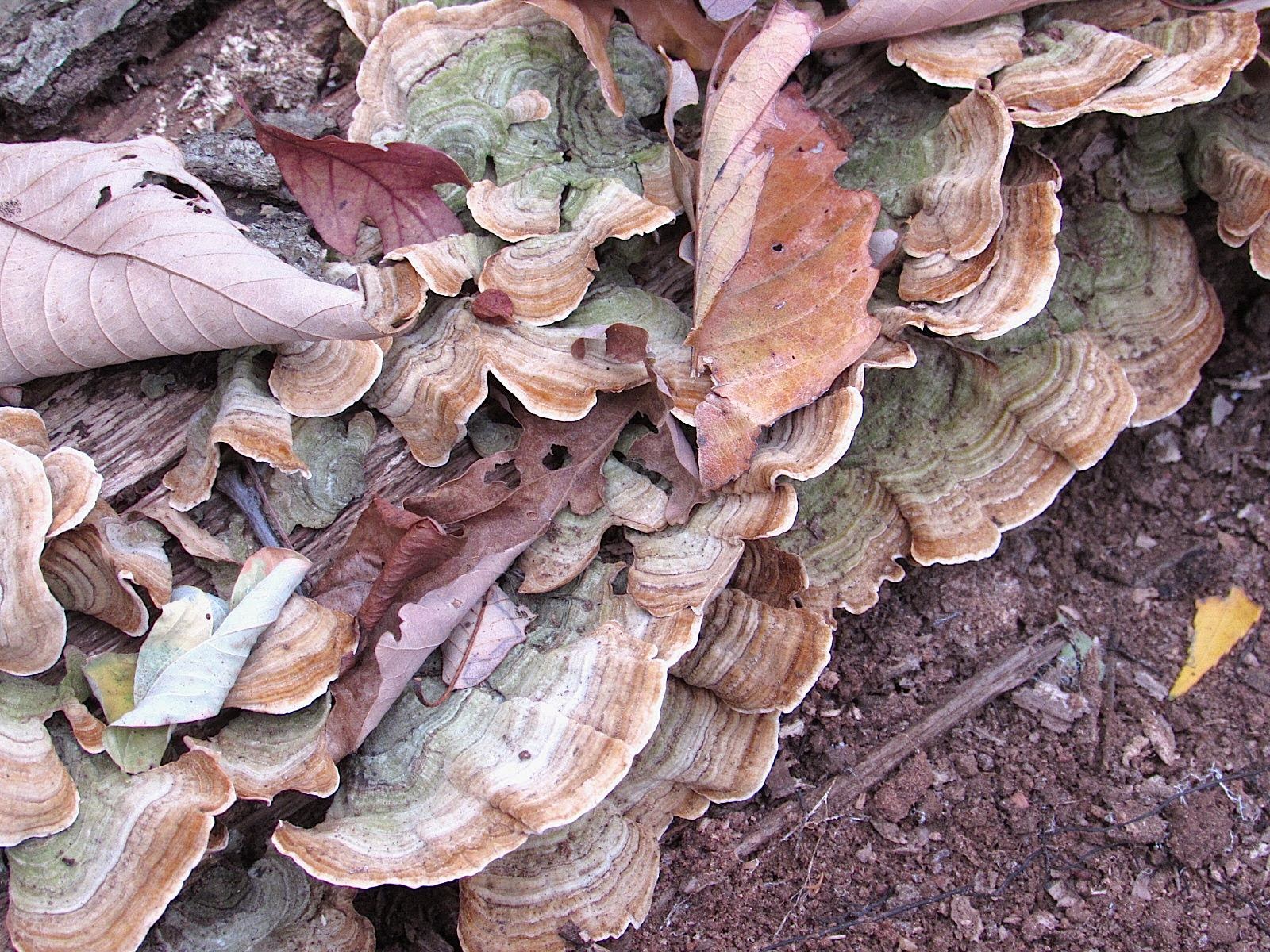
I really like the ruffled shape of the fungi commonly known as turkey tail or Trametes versicolor and the mushrooms were kind of like rounded buttons. Looks like all those fungi that grow on wood in this shape are related and are generally called polypores or bracket fungi Wiki has a discussion of this that was enlightening for a novice.

The colors of the trees were everything from brown to red and yellow and a little pinkish orange.

Tulip poplar leaves were so high in the tree tops that I had to use my zoom lens to distinguish them. Then a new tree for me was the lovely orange pink black gum tree below. These leaves were more down to earth in the understory of the tall oaks and poplars.

Red maple leaves were there and best seen on the ground among the fallen oak leaves they stood out.

One plant I hadn't ever seen or known about is the maple-leaf viburnum ,Viburnum acerifolium which turns a sort of red or pink in fall making it stand out but the plants.

rich pink of Maple-leaf Viburnum


My last photos are of the view down into the woods where a gully runs and some of the huge trees had fallen making an opening in the forest canopy. The one plant I didn't expect to see was mountain laurel Kalmia latifolia and there was a lot of it all along the trails and off in the woods on the forest floor. The link on mountain laurel will take you to the wiki page that has some great photos of the beautiful spring flowers. This would be fun to see next spring right here in Washington DC. I am so glad we ventured out with Mary Pat Rowen taking Meron, our Ethiopian friend, who is very brave to go out for a long forest walk in the cold but I think she had a great experience just like Keith and I did.
 |
| Mary Pat Rowen and Meron |
 |
| Dan, Keith, Meron, with Mary Pat who gets us started. |
 |
| Dave, ______, Dwight, Dan, Keith, Meron, Mary Pat as we began the sky was gray and the wind was cold and everyone was adjusting to the weather... later it warmed up and we enjoyed a visit to the museum where they had a great beading and quilt display. |


 Posts
Posts


