Showing posts with label trees. Show all posts

Wednesday, November 18, 2015

Photos of late in Oranges!

Thought I would share a few of my autumn photos from the iPhone that I carry everywhere and use liberally to collect oranges and things that catch my fancy. Quilting season and orange season are upon us! Happy Holidays. 


walking on the Highline elevated native plants park in NYC with John Kelly. 

free to view art installation at the Whitney in NYC October 2015


Posing with some of my friends from the 1980's nightclub Pyramid of the lower East Village  in front of my Log Cabin quilt exhibited in NYC as part of the 'what happened to those creative people from the good old days...


Now it's nearly time to go take a walk and see what new colors appear on the way. 

Sunday, April 26, 2015

Walking the bluebell trail along Bull Run

I went for a walk at the beginning of the bluebell season the native flowers that are so many shades of purple to blue and even white in some rare cases growing in the flood plain where they get watered a lot this time of year. Bull run is the creek that passes under the old stone bridge in the Manassas Battlefield park where this bluebell trail begins. There are lots of different native flowering plants that poke up their heads up in these early spring weeks between freezing cold and the forest's leaves open and blocking the light that falls warming the earth below. All these native flowers are a delight and I have gone to the trail a few times this year to check on the bluebells progress.

Blue bells are the largest and most dramatic of the native flowers in the woods. They stand about a foot high and grow in clumps forming a carpet of lavender blue and fresh green on the edges of the creek in the low flood plain areas.


 The flowers are difficult to photograph as the eye sees them, the blue really jumps out  of those green areas but I haven't found a way to show that the same way we see.
 Mixed in the flowering forest floor are little spotted leaves and bright yellow flowers the Trout Lilies.
  
 Near by and a little earlier were the Dutchman's Breeches a cousin to the bleeding hearts so many of us love in our own gardens. Spring beauties also are abundant along the trail and are very short beside the taller flowers but native bees depend on their abundant early blooms.

On a sunny day the best places to take the wildflower photos is where shade falls from the tree's trunks so the high contrast is reduced and the colors show up. 


Tree frogs are singing to their mates all over the wooded areas along the creek's edges.
 On my hike, I met a group of three Park Rangers riding on horseback who said hello and continued down the trail towards the bridge. As it was free day they didn't ask for a pass or anything but greet me and keep on walking... 
This trail comes to a point where the creek banks are too steep to continue at the edge of Bull Run and the flora change as the trail turns up towards the wooded hill and an evergreen area. Mosses and a few ferns as well as one of my favorites the bluet a tiny blue flower with four petals that is sky blue. My photo blew out the color and made them look white. Found in the damp shadows they are so small you have to hunt for them at the trial edge not far from the mossy areas that are bright green this time of year. 


Moss sends up it's red stemmed flowers. 
tiny ferns grow in very specific areas. Here in a depression of a big tree trunk and all along the edge of a rocky cliff over the creek below. 


Wintergreen's leaves are still showing deep in the woods 

Pine trees and hemlocks are at the top of the hill and the trail edges are covered with fallen leaves in addition to the red pine needles

At the top of the hill the trail opens out to a huge field and runs along the edge for a ways where the wind has blown over many trees but reveals the flowering red bud tree seeking light it's a native that is wide spread and domesticated for home gardens as well as roadside when you drive through the country. This area gets lots of sun and wind and the old Virginia Red Cedars and scrub pines take a beating as well as bleach out to a fine silvery color when they fall. 


the panoramic view from the top of the hill on this trail of the battlefield opens to the big blue sky. 

Back to the bluebells... and if you look closely you might see the spring beauties little white flowers near by in these photos. 


Here I saw a pond that is collected rainwater 50 yards from the creek's edge in the flood plain area. Can you make out the green topped with bluebells? The National Parks are a wonderful experience when every you have time to go and enjoy a visit with nature. The bluebells are a great time to go but I can't remember ever going when I didn't enjoy visiting with the plants and creatures of the parks. I am thankful for the conservationist movement that created these amazing natural retreats from our over developed communities. 


Monday, November 3, 2014

Fort Stanton walk

Sunday with all the wind and the burst of cold from the northwest we ventured out with our Brookland neighbor and landscape architect to meet up with other native plant society members to do a walk in Fort Stanton park. Mary Pat Rowen from the Maryland native plant society was our guide. The park is in Anacostia with the community museum perched right in the middle of it making a great place to warm up and see a little art. The point of our walk was to see the native plants and trees of our forests and help each other learn about them. I took photos and I can't describe everything but I wanted to share a little of the experience with you and tell some of what I learned. The first image is of Mary Pat Rowen who was our leader on the walk. She also gave Keith, Meron and myself a ride down to the park and home making it even more fun because we got to see the city from a new point of view. Here she describes the difference between two types of Hickory tree side by side with bright yellow leaves and the Anacostia Community Museum in the background.
We had a total of eight naturalist beginners to expert on the hike. 
Along the two hour walk we were in the woods protected from most of the wind which was blowing hard up above in the tree tops some 75 feet or more above. This civil war era fortress was constructed on a hill overlooking Washington DC from the east side of the Anacostia River. At the apex of the fortress hill there was a commanding view of the city and everything around it. We could see all the major landmarks from Brookland's Basilica, National Cathedral, Capitol dome in scaffolding this year, the whole of Roslyn Va. the Pentagon and Air Force memorial sculpture, looking around to National Airport and the rivers that wrap around them all as well as closer in view the Navy Yard and a stadium... It was astonishing to see this all from one vantage point. The point of this trip wasn't sight seeing but that was a nice bonus thanks to Mary Pat stopping to show us the commanding views before we trekked off into the woods. Once inside the woods we got tips on how to tell one type of oak from the next and many other tree's by the shapes of their leaves and the bark on the mature tree. Some we scratched to get a sniff of the scent in the plant like Sassafras and Spice bush. 

First view of the trail shows that someone decided to dump some tires and we could see how the invasive plants seem to grow mostly at the edges of the woods. She explained that the soil isn't rich in the right ways to support them in the depths of the woods where the natives still rule. 
Right off I was looking for plants I knew to point out. The green Brier a vine that has sharp long thorns was the first after poison ivy and English ivy that came to view. This plant had rich blue berries hanging on the mostly bare stems. They form low thickets that are refuge for birds and small animals. But I didnt' know there were two types of green brier plant until the other type was pointed out. It is smaller and has a longer oval type leaf and is light color on the underside. The thorns on the vine are much smaller but there are dozens of them compared to the smooth green brier. Very distinctive the two plants are so different but similar in a few ways. 

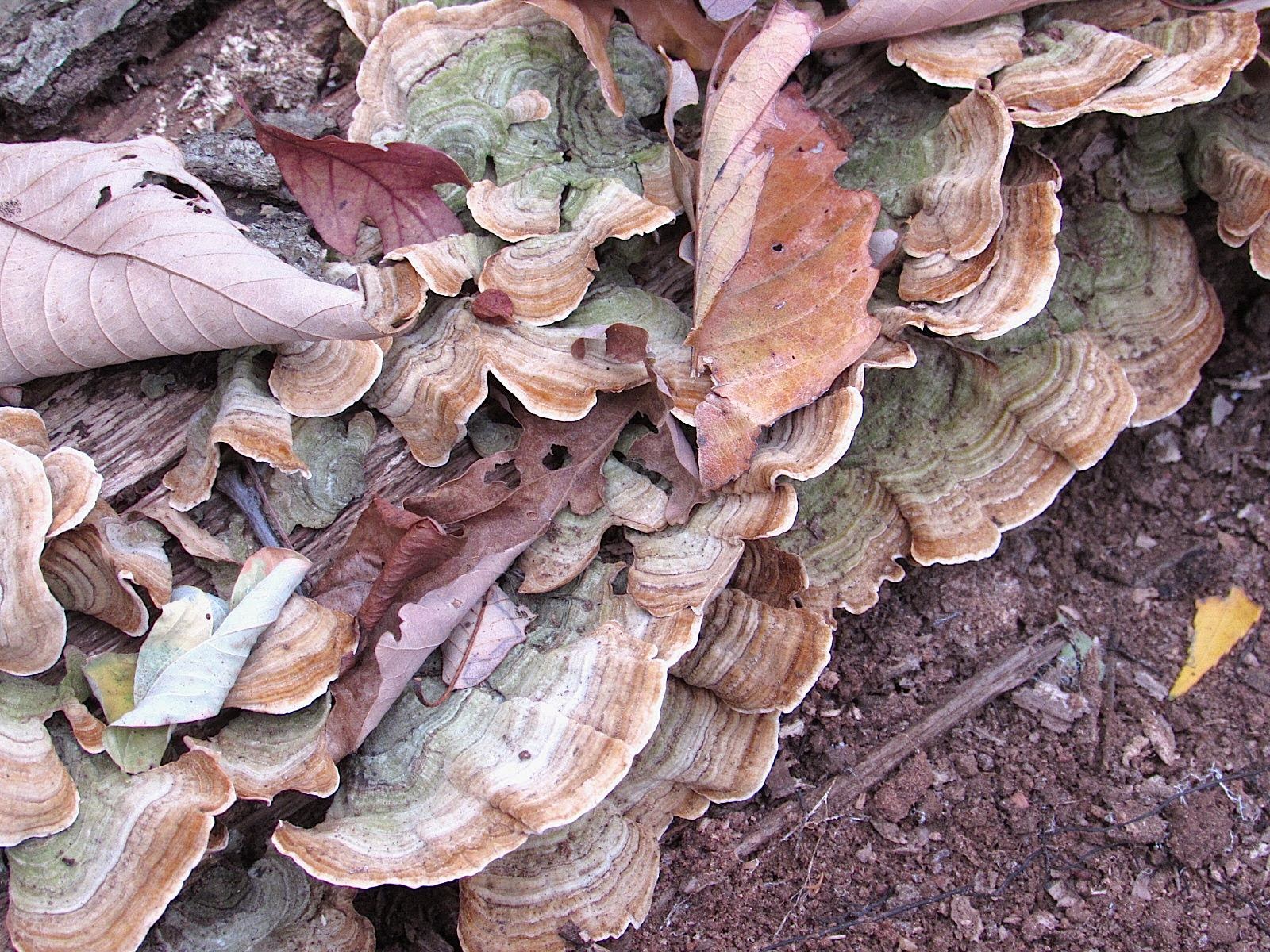
Next think I noticed was a fallen tree covered with my favorite fungus I called lichen. I now realize I was wrong, it is a type of fungus classified with mushrooms. That caused some debate we also discovered another type of mushroom also growing on the same logs. 

I really like the ruffled shape of the fungi commonly known as turkey tail or Trametes versicolor  and the mushrooms were kind of like rounded buttons. Looks like all those fungi that grow on wood in this shape are related and are generally called polypores or bracket fungi Wiki has a discussion of this that was enlightening for a novice. 
The colors of the trees were everything from brown to red and yellow and a little pinkish orange. 
Tulip poplar leaves were so high in the tree tops that I had to use my zoom lens to distinguish them. Then a new tree for me was the lovely orange pink black gum tree below. These leaves were more down to earth in the understory of the tall oaks and poplars.

Red maple leaves were there and best seen on the ground among the fallen oak leaves they stood out. 

One plant I hadn't ever seen or known about is the maple-leaf viburnum ,Viburnum acerifolium which turns a sort of red or pink in fall making it stand out but the plants.

rich pink of Maple-leaf Viburnum 

My last photos are of the view down into the woods where a gully runs and some of the huge trees had fallen making an opening in the forest canopy. The one plant I didn't expect to see was mountain laurel Kalmia latifolia and there was a lot of it all along the trails and off in the woods on the forest floor. The link on mountain laurel will take you to the wiki page that has some great photos of the beautiful spring flowers. This would be fun to see next spring right here in Washington DC. I am so glad we ventured out with Mary Pat Rowen taking Meron, our Ethiopian friend, who is very brave to go out for a long forest walk in the cold but I think she had a great experience just like Keith and I did. 
Mary Pat Rowen and Meron 

Dan, Keith, Meron, with Mary Pat who gets us started.

Dave, ______, Dwight, Dan, Keith, Meron, Mary Pat as we began the sky was gray and the wind was cold and everyone was adjusting to the weather... later it warmed up and we enjoyed a visit to the museum where they had a great beading and quilt display.