Showing posts with label nature. Show all posts

Monday, November 3, 2014

Fort Stanton walk

Sunday with all the wind and the burst of cold from the northwest we ventured out with our Brookland neighbor and landscape architect to meet up with other native plant society members to do a walk in Fort Stanton park. Mary Pat Rowen from the Maryland native plant society was our guide. The park is in Anacostia with the community museum perched right in the middle of it making a great place to warm up and see a little art. The point of our walk was to see the native plants and trees of our forests and help each other learn about them. I took photos and I can't describe everything but I wanted to share a little of the experience with you and tell some of what I learned. The first image is of Mary Pat Rowen who was our leader on the walk. She also gave Keith, Meron and myself a ride down to the park and home making it even more fun because we got to see the city from a new point of view. Here she describes the difference between two types of Hickory tree side by side with bright yellow leaves and the Anacostia Community Museum in the background.
We had a total of eight naturalist beginners to expert on the hike. 
Along the two hour walk we were in the woods protected from most of the wind which was blowing hard up above in the tree tops some 75 feet or more above. This civil war era fortress was constructed on a hill overlooking Washington DC from the east side of the Anacostia River. At the apex of the fortress hill there was a commanding view of the city and everything around it. We could see all the major landmarks from Brookland's Basilica, National Cathedral, Capitol dome in scaffolding this year, the whole of Roslyn Va. the Pentagon and Air Force memorial sculpture, looking around to National Airport and the rivers that wrap around them all as well as closer in view the Navy Yard and a stadium... It was astonishing to see this all from one vantage point. The point of this trip wasn't sight seeing but that was a nice bonus thanks to Mary Pat stopping to show us the commanding views before we trekked off into the woods. Once inside the woods we got tips on how to tell one type of oak from the next and many other tree's by the shapes of their leaves and the bark on the mature tree. Some we scratched to get a sniff of the scent in the plant like Sassafras and Spice bush. 

First view of the trail shows that someone decided to dump some tires and we could see how the invasive plants seem to grow mostly at the edges of the woods. She explained that the soil isn't rich in the right ways to support them in the depths of the woods where the natives still rule. 
Right off I was looking for plants I knew to point out. The green Brier a vine that has sharp long thorns was the first after poison ivy and English ivy that came to view. This plant had rich blue berries hanging on the mostly bare stems. They form low thickets that are refuge for birds and small animals. But I didnt' know there were two types of green brier plant until the other type was pointed out. It is smaller and has a longer oval type leaf and is light color on the underside. The thorns on the vine are much smaller but there are dozens of them compared to the smooth green brier. Very distinctive the two plants are so different but similar in a few ways. 

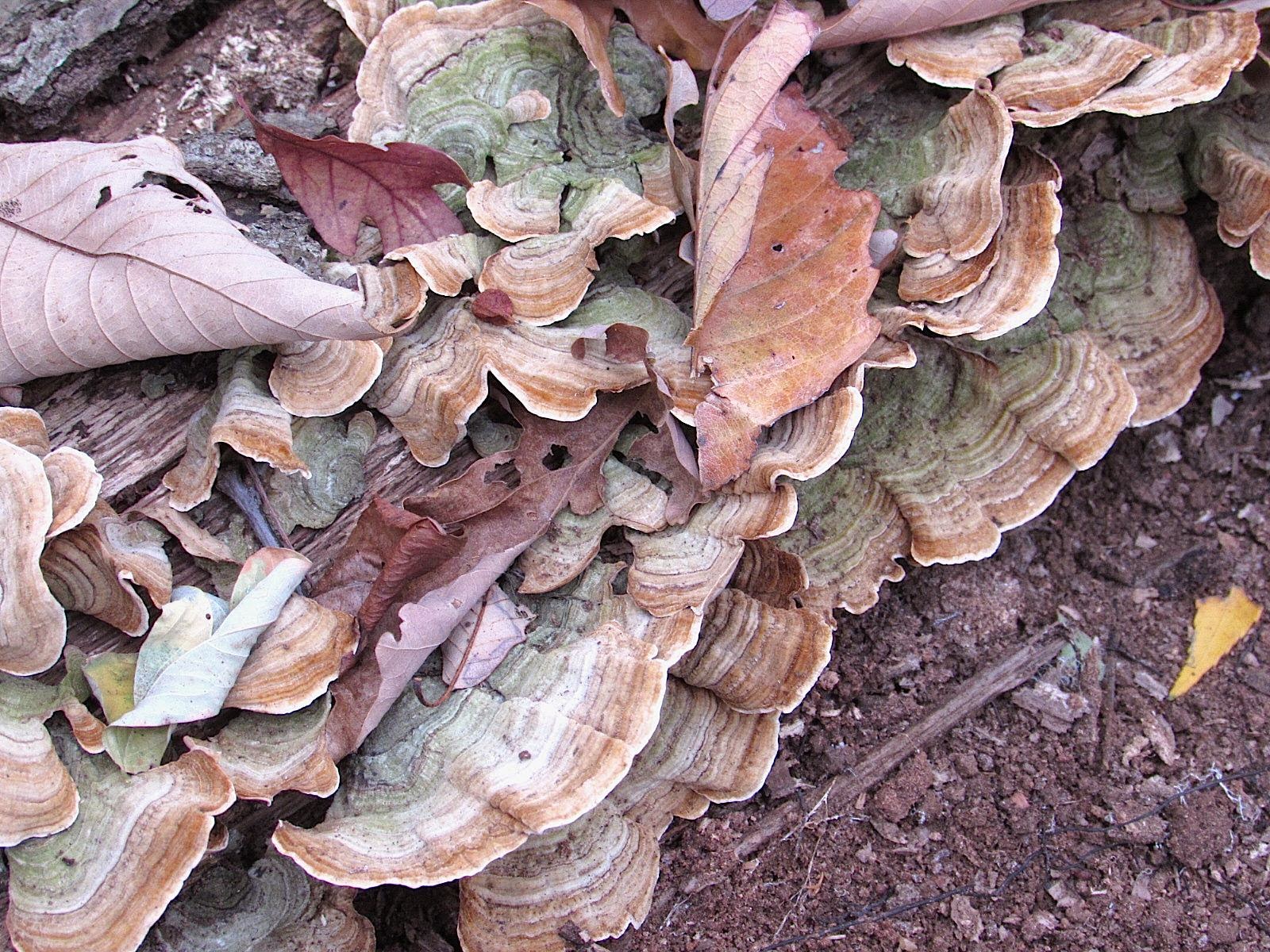
Next think I noticed was a fallen tree covered with my favorite fungus I called lichen. I now realize I was wrong, it is a type of fungus classified with mushrooms. That caused some debate we also discovered another type of mushroom also growing on the same logs. 

I really like the ruffled shape of the fungi commonly known as turkey tail or Trametes versicolor  and the mushrooms were kind of like rounded buttons. Looks like all those fungi that grow on wood in this shape are related and are generally called polypores or bracket fungi Wiki has a discussion of this that was enlightening for a novice. 
The colors of the trees were everything from brown to red and yellow and a little pinkish orange. 
Tulip poplar leaves were so high in the tree tops that I had to use my zoom lens to distinguish them. Then a new tree for me was the lovely orange pink black gum tree below. These leaves were more down to earth in the understory of the tall oaks and poplars.

Red maple leaves were there and best seen on the ground among the fallen oak leaves they stood out. 

One plant I hadn't ever seen or known about is the maple-leaf viburnum ,Viburnum acerifolium which turns a sort of red or pink in fall making it stand out but the plants.

rich pink of Maple-leaf Viburnum 

My last photos are of the view down into the woods where a gully runs and some of the huge trees had fallen making an opening in the forest canopy. The one plant I didn't expect to see was mountain laurel Kalmia latifolia and there was a lot of it all along the trails and off in the woods on the forest floor. The link on mountain laurel will take you to the wiki page that has some great photos of the beautiful spring flowers. This would be fun to see next spring right here in Washington DC. I am so glad we ventured out with Mary Pat Rowen taking Meron, our Ethiopian friend, who is very brave to go out for a long forest walk in the cold but I think she had a great experience just like Keith and I did. 
Mary Pat Rowen and Meron 

Dan, Keith, Meron, with Mary Pat who gets us started.

Dave, ______, Dwight, Dan, Keith, Meron, Mary Pat as we began the sky was gray and the wind was cold and everyone was adjusting to the weather... later it warmed up and we enjoyed a visit to the museum where they had a great beading and quilt display. 


Friday, August 15, 2014

Walking Unfinished Railroad Battlefield trail

In Manassas National Battlefield there are several trails for walkers and Keith and I decided to take a walk along the Unfinished Railroad trail starting at the Sudley United Methodist Church yard off route 234.  Which links up with the Loop trail about a mile off 234 see the link to the parks trail map above. We parked in a tiny turnaround and got out to walk along what I remembered from my high school days as a wooded path raised up about eight feet from the forest floor. It was only partly on the raised train track bed and in some places on the level of the woods and meadows that surround that incomplete train track bed.

Keith waited at the trail head up there on the left in this picture while I took this image of the purple iron weed blooming in the tall grassy area near the parked car. 
Red clay and shale is the soil I recognize from gardening in Manassas shown bare here along this row of red cedar trees where we began. Soon it became grassy and we later found that poison ivy is in the grass. Fully protecting yourself from poison ivy exposure and some sort of tick repellent are highly recommended for this hike. We didn't use either and suffered the poison ivy itchy rash and a deer tick bite for several days afterwards. 

The great surprise for me was the number of wildflowers and interesting things growing along this trail as well as a few animal sightings some of which I have image of to share. 
First was the sunny meadow flowers like queen Ann's lace and bright yellow rudbeckia the black eyed Susan of the wild with signs of goldenrod beginning to bloom

.


From there things began to show up I didn't know at all and was curious to document as we walked in hopes of finding names for them when we got home. This seems to be a sumac in bloom and to be sure it was a super pollinator for the native wasps and bees were all over the flowers. 


I am really fond of things that have that dark blue iridescent color like these wasp wings but they were tricky to capture moving hyper fast around on all those flowers all of them seemed to be energized from the nectar. in the distance I saw a pale pink-lavender flowers I thought was a liatrus and with the zoom bringing it into view I discovered it was host to a little skipper butterfly


There were a lot of tiny flowers. 


some narrow leaf mountain mint blooming white


this pretty little white flower in the tall grass reminded us of baby breath but was much prettier  

One lone tiger swallowtail butterfly showed up way out in the field visiting a tall purple flower the vistas from the edge of the fields were so pretty to soak in as we walked the flat straight railroad trail. 


Then the trail began to be grassy and we found that we were walking along side of the raised train track bed which is mowed by the park service now and then. It is here that I suspect that we tread on the poison ivy hiding in the ankle brushing grasses.  
Soon meadow turned to woods and we met different creatures and the only other two hikers we saw in our two hour visit. The showed up soon after we scared up a flock of turkey poult and their mom in that deep grass munching bugs and grass and maybe Polk berries from a dense grove. Scared us as they took wing from out of the grass 


Then we got in a deep part of the woods and found mushrooms and a lone box turtle at the edge of the trail!


mossy areas and leaf littler invite the native ferns to take root in dappled shade... leathery Christmas fern that is green all year round and a more sensitive one I don't know the name of were here and there sometimes side by side.


A tiny fern that is no more than 10 inches tall with sprouts about 2 inches long was on the edge of another section. We used to have these volunteer growing in the mortar between bricks of a garage on 9th St. NW years ago. 
I chased these two butterflies in the woods finding it very difficult to get a good shot. One had an orange yellow section the other was all grays on the outer wings. Never opened up to show the back sides of their wings except in flight. Then we came to a clearing and saw these skippers one orange and the other browns and white spots.  


Then while photographing a tiny spray of lavender flowers:

  I stepped back and noticed just behind those flowers stood a single straight stalk covered with brown and green flowers which didn't have any leaves. 
I was impressed with the look of it and took a great deal of effort to get a clear photo so I could identify it for this post. We are learning it was a  Cranefly orchid  


This orchid is a woodland orchid that is pollenated by nocturnal moths by depositing pollen on the moth's eye which it then carries to the next flowering orchid. Cranefly or Crippled Cranefly Orchid is the only one of this species that is in north America latin name: Tipularia discolor. 


 We found one we thought was St. John's Wort - Hypericum not sure which type but the flower is right. I didn't have a book to look up details but they were shrub like and had smaller leaves than the commercially grown version we see in nurseries that have a flower two to three times this size and a big leaf.
The next flowering plant we came across was a mimulus ringens allegheny or the Square Stemmed Monkey Flower. Lavender color on a 18 inch tall plant that has very square buds. It is one that would be nice to have in a garden very sturdy and visible flowers. Unlike many of the flowers we saw that nearly needed a microscope to see them mixed in the grasses and vines. 


 Square stemmed Monkey flowers
This yellow flower with those fern like leaves was one I recognized from the lecture we went to at the Native Virginia Plant Society a few weeks ago and my book tells me it is a partridge pea. 
Then there is this lavender pink flower I noticed on the edge of the trail that had a great  S shaped stem with those little triplets of leaves. It turns out it was also the tall flowering stalk that the skipper butterfly was feeding on in earlier pictures from the field. It's Alfafa  which has escaped into the wild from cultivated fields. So that isn't native but it has gone wild. 


 Next was this pink wild bean vine which had flowers the size of my thumb nail. It was twisted up with Japanese honey suckle vine leaves but if you look carefully the blue green leaves below the flowers are the bean leaves which grow in groups of three.

last but not least was the pretty pink swamp milk weed blooming in the field by the car when we got back to leave for home. Ticks hiding in Keith's pants and poison ivy wrapped into our shoes and socks waiting to show us a good time when we got back to DC the next day. It was all worth it for me because I can't ever remember going to the battle field and finding so many wild flowers in bloom. Thanks for any questions you might have about the flowers or the park hike.